WalkingPad R2 Review 2026: Best Premium Walk-Run Pad
WalkingPad R2 review: discontinued and replaced by the R3 Hybrid+. 17x47-inch belt, 7.5 mph running, fold-upright storage. The R3 is the model to buy now.
| Product | Best For | Price | Action |
|---|---|---|---|
 WalkingPad R3 Hybrid+ 2-in-1 TreadmillEditor's Choice Premium walk-run versatility with upright storage | Premium walk-run versatility with upright storage | View on Amazon | |
 WalkingPad X21 Double-Fold Treadmill Runners who need vertical storage and a wide belt | Runners who need vertical storage and a wide belt | View on Amazon | |
 | Budget-conscious tall users | View on Amazon | |
 | Widest belt and longest stride at mid-range price | View on Amazon |
Product prices and availability are accurate as of the date/time indicated and are subject to change. Any price displayed on this site at the time of purchase will govern the sale of the product. As an Amazon Associate, we earn from qualifying purchases.
Verdict up front: Heads up — the WalkingPad R2 has been discontinued. KingSmith replaced it with the newer WalkingPad R3 Hybrid+, which is the model we now recommend and the one every link on this page points to. The R3 is our premium walk-run pad pick. It keeps everything that made the R2 great — a 17 x 47-inch belt and real 7.5 mph running — and adds a one-piece aluminum alloy frame, dual side handrails, a 265 lb capacity, and a double-fold design that stores upright against a wall. If the KingSmith A1 Pro was your pick before it went out of stock, the R3 is the machine it was pointing toward.
Reviewed by Jerry Mitchell, who has researched and spec-compared 20+ walking pads for TheBestWalkingPads.com since 2024.
TheBestWalkingPads.com is a participant in the Amazon Services LLC Associates Program. We earn a small commission on qualifying purchases at no extra cost to you.
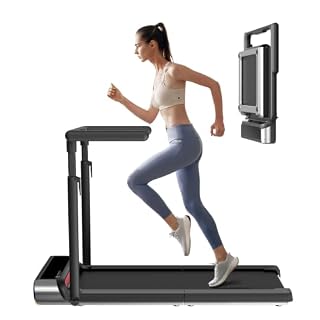
WalkingPad R3 Hybrid+ 2-in-1 Treadmill
by WalkingPad
Best for: Premium walk-run versatility with upright storage
Key Features
- Brushless motor, 0.5-7.5 mph (4 mph in under-desk mode, up to 7.5 mph with handrail raised)
- 2-in-1: lower the height-adjustable handrail to walk under a desk, raise it to run
Pros
- + Genuine walk-and-run: 4 mph under-desk mode, 7.5 mph with the handrail raised
- + Double-folds and stores upright — minimal storage footprint
Cons
- - Premium price point
- - Heavier than walk-only pads
How we assessed it: This review is built on our spec-by-spec analysis of the WalkingPad R-series — comparing the discontinued R2's published specs against the spec upgrades KingSmith made on the new R3 Hybrid+ successor (one-piece aluminum frame, dual side handrails, 265 lb capacity, KS Fit app) — cross-checked against verified-buyer reviews of both models. Pricing and stock are verified against Amazon and refreshed automatically.
Who is the WalkingPad R2 for?
Heads up: the WalkingPad R2 has been discontinued — KingSmith replaced it with the newer WalkingPad R3 Hybrid+, which is the model we now recommend. Everything below applies to the R3 you can buy today. Walking while you work is one of the simplest ways to offset a sedentary day — Mayo Clinic notes that regular walking improves cardiovascular fitness and helps with weight management. The R3 earns its premium price tag for three specific buyer types:
Home office walkers who also want to run. The R3 is a 2-in-1 that legitimately handles both modes — handrail lowered for slow under-desk walking during calls, handrail raised for 7.5 mph running in the evening. You do not need two machines.
Small-apartment buyers who have run out of wall space. The R3's double-fold upright storage is the differentiator at this tier. It stands against a wall in a slim depth — less intrusive than a kitchen appliance. Every other folding treadmill in this price range takes 20–40 square feet of floor space even when folded.
Former A1 Pro buyers. The KingSmith WalkingPad A1 Pro went globally out of stock in early 2026. The R3 is the direct successor in the R-series — same KingSmith lineage, wider belt, better specs, and the same premium-build ethos. If you were an A1 Pro buyer, the R3 is where the brand went.
If you only need walking under a desk and nothing else, the WALKINGPAD Z1 or the KingSmith P1 offer the same 47-inch belt at a fraction of the cost. The R3's premium is paid for by running capability and the double-fold upright storage system.
Specs at a glance
The R2 has been discontinued; the specs below are for the current WalkingPad R3 Hybrid+ successor, which is what every product link on this page resolves to.
| Spec | WalkingPad R3 Hybrid+ (R2 successor) |
|---|---|
| Belt size | 17" × 47" |
| Speed range | 0.5–7.5 mph |
| Weight capacity | 265 lbs |
| Motor | Quiet brushless |
| Storage mode | Double-fold (flat OR upright) |
| Handrail | Height-adjustable dual side handrails |
| App | KS Fit + LED display |
| Frame | One-piece aluminum alloy |
| Assembly | Fully assembled out of box |
| Listing | Newer listing, backed by KingSmith's R-series track record |
Can you run on the WalkingPad R2?
Heads up: the R2 has been replaced by the WalkingPad R3 Hybrid+ — same walk-run format, so this all applies to the model you can buy today.
Yes — with the height-adjustable handrail raised, the R3 runs to a genuine 7.5 mph, and its 17-inch-wide belt is wide enough for a natural running gait. That belt is the most important spec for most buyers. The 17-inch width clears the stride — narrower belts (15–16 inches) feel constraining above 5 mph. The 47-inch length covers users up to 6'2" walking and running at moderate pace. For very tall users (6'3"+) or those with a long running stride, the WalkingPad X21's 18.1 × 47.6-inch belt adds a meaningful margin.
The quiet brushless motor runs smoothly from 0.5 mph (a near-stop for easy stretching) through 7.5 mph (a solid running pace for most recreational runners). Owner reviews across the R-series consistently report no speed hunting or belt slip at either end of the range. KingSmith rates its motors for continuous duty — 7.5 mph sustained is within spec, not a peak figure.
The R3's 2-in-1 mode works exactly as advertised: lower the handrail to walk under a desk, raise it to run. In under-desk mode the pad runs at about 4 mph — enough for desk-walking (most people walk at 1.5–3.5 mph under a desk) and not constraining in practice. Dual side handrails add stability once you raise it to run.
How loud is the WalkingPad R2?
The R2 has been replaced by the WalkingPad R3 Hybrid+, which uses the same quiet brushless motor — so the noise profile carries over. At a 2–3 mph walk it stays quiet enough for calls; running adds noticeable motor and belt noise — apartment-friendly for walking, mat-recommended for running. KingSmith does not publish an official dB rating, which is typical for premium models where noise character matters as much as the raw number. In practical terms:
- Walking at 2–3 mph: The quiet brushless motor is unobtrusive — quiet enough for calls, easily missed through a closed door.
- Running at 5–7.5 mph: Motor noise increases noticeably, and belt impact creates vibration. This is normal for any treadmill running at pace. A cushioned mat under the deck reduces both noise and floor vibration significantly.
For walk-only apartment users, the R3 is as quiet as any walking pad in this price tier. For runners in apartments with downstairs neighbors, a mat is not optional — it is required for courtesy.
The WALKINGPAD Z1 is rated below 40 dB and remains the quietest option in the catalog at walking speeds, though it lacks running capability.
How does the WalkingPad R2 store?
The R2 is discontinued; its successor, the R3 Hybrid+, keeps and improves the signature storage trick. The R3 uses a double-fold design that stands upright against a wall — the smallest storage footprint of any 2-in-1 treadmill in this price tier. This is its most distinctive feature. Unlike traditional folding treadmills that halve their length but still occupy 10–15 square feet of floor space, the R3 stands vertically against a wall.
Owners consistently describe folding the R-series from flat to wall-stored upright as a matter of seconds — quick enough that putting it away after a session is barely an afterthought.
This is a genuine apartment win. In a 600–900 square foot space, the difference between a treadmill that disappears against a wall and one that claims a permanent corner is measurable in daily quality of life.
The mechanism is a double fold: the deck and frame hinge and lock upright. It is stable freestanding once locked — you are not balancing it against the wall. Moving between flat (under-desk use), stored-flat (slid under a bed or couch), and stored-upright (wall position) takes only seconds once you are familiar with the motion.
The R3 is dense and heavier than walk-only pads (which are typically 40–55 lbs). Moving it between rooms is a two-person job.
App and controls
The R3 Hybrid+ (the R2's successor) connects to KingSmith's KS Fit app via Bluetooth — you can track steps, speed, time, distance, and workout history. The app is genuinely useful rather than superficial: it stores workout history, offers guided walking programs, and allows fine speed adjustments from your phone.
Physical controls: the R3 includes a remote control for speed adjustment and start/stop, plus an LED display that shows steps, speed, time, and distance. For under-desk use, the remote is the primary interface (reaching the deck display during a standing session is awkward). Remote control is standard on all WalkingPad models.
The app control is a premium differentiator over basic walking pads, and for buyers who want workout tracking, the KS Fit app and on-deck LED display together give you steps, speed, time, and distance at a glance.
How the R3 (R2 successor) compares
WalkingPad R3 vs WalkingPad A1 Pro
Lineup note: The WalkingPad R2 has been discontinued and replaced by the R3 Hybrid+, which is what the comparisons below use. The KingSmith WalkingPad A1 Pro is also globally out of stock on Amazon and KingSmith.com with no confirmed restock date; its column uses the A1 Pro's last verified specs.
| Spec | R3 Hybrid+ | A1 Pro |
|---|---|---|
| Belt width | 17" | 16.5" |
| Belt length | 47" | 47.2" |
| Max speed | 7.5 mph | 3.72 mph (walk only) |
| Weight capacity | 265 lbs | 220 lbs |
| Motor | Quiet brushless | Brushless (1.25 HP) |
| Running | Yes (handrail up) | No |
| Upright storage | Yes (double-fold) | No |
| Handrails | Dual side handrails | None |
| App | KS Fit + LED display | KS Fit |
| In stock | ✓ Yes | ✗ No |
The R3 is better in every spec category and the only one you can actually buy. The A1 Pro's 47.2-inch length is marginally longer than the R3's 47 inches — a 0.2-inch difference that is meaningless in practice. The R3 is about $300 more than the A1 Pro's last list, and it wins on width, speed range, capacity, frame, handrails, storage, and availability.
If you were specifically looking for the A1 Pro before it went out of stock, the R3 is the right call. For a full breakdown of every available alternative — including the P1 if the R3 is over budget — see our WalkingPad A1 Pro alternatives guide.
WalkingPad R3 vs WalkingPad X21
| Spec | R3 Hybrid+ | X21 |
|---|---|---|
| Belt width | 17" | 18.1" |
| Belt length | 47" | 47.6" |
| Max speed | 7.5 mph | 7.5 mph |
| Weight capacity | 265 lbs | 220 lbs* |
| Storage | Double-fold upright | Double-fold upright |
| Speed control | App + LED display | Rotary dial + app |
| Handrails | Dual side handrails | Handrail |
*Amazon listing shows 220 lbs; manufacturer rates higher.
The X21 and the R3 land at the same price. The X21 gives you a wider belt (18.1 vs 17 inches) and a rotary speed dial that many users prefer for running, so it is the right choice if belt width is your top priority — especially for users over 6'2" or with a wide running gait. The R3 counters with a higher 265 lb weight capacity, dual side handrails, and a one-piece aluminum frame, making it the stronger all-round pick for most buyers.
WalkingPad R3 vs KingSmith P1
| Spec | R3 Hybrid+ | P1 |
|---|---|---|
| Belt width | 17" | 15.75" |
| Belt length | 47" | 47" |
| Max speed | 7.5 mph | 3.7 mph (walk only) |
| Motor | Quiet brushless | Brush (1 HP) |
| Upright storage | Yes (double-fold) | No |
| Running | Yes | No |
The P1 is the right pick if you only need walking and want to stay in the KingSmith family at a lower cost. The R3 is right if you want running, a wider belt, or the double-fold upright storage system. The $450 gap is real — if running is not in your use case, it is money that buys no walking benefit.
Who should not buy the WalkingPad R2 (R3)
The R2 is discontinued; this applies to its R3 Hybrid+ successor.
Budget-constrained buyers who only need walking. The KingSmith P1 or the WALKINGPAD Z1 match the R3's belt length at walking speeds for hundreds less.
Heavier users over 265 lbs. The R3 is rated at 265 lbs. The DeerRun 4-in-1 carries 300 lbs and is the only compact pad in our catalog for that weight range.
Buyers who need motorized incline. The R3 has no incline capability. For incline training, a traditional treadmill is the right tool. See our walking pad vs treadmill guide for a full comparison.
Users who need Prime shipping. Check the R3 listing at time of purchase — Prime eligibility can change, and the P1 and Z1 are Prime-eligible.
How to Check Whether the R3 Is on Sale
The R2 has been replaced by the WalkingPad R3 Hybrid+. Because this is a premium model, confirm that any comparison uses the current R3 Hybrid+ ASIN rather than the discontinued R2 listing.
Our walking pad deals and current-price page shows the latest available feed for the R3 and competing walk-run models. Compare that figure with the recent normal selling price, not just a crossed-out list price.
Price-check tip: Confirm the listing says R3 Hybrid+ and matches the 17-by-47-inch belt and 7.5 mph specification before buying.
Assembly and first impressions
The R3 Hybrid+ (the R2 successor) ships fully assembled — no tools, no bolts, no setup time beyond unboxing and sliding the deck out flat. This is a genuine differentiator versus traditional treadmills that often arrive in pieces and require 45–90 minutes of assembly.
Out of box, the R3 is dense and heavier than walk-only pads (which run 40–55 lbs for a typical walking pad). If you are buying alone and live in an apartment above the ground floor, plan for the delivery.
First-run setup: plug in, download KS Fit, pair via Bluetooth, run a quick belt test at low speed. The app walks through this in under five minutes.
What buyers say
The R3 Hybrid+ is a newer Amazon listing, so its review count is still building — but it inherits the WalkingPad R-series track record that buyers came to trust on the R2. Across that lineage, the feedback patterns are consistent:
Most common praise: The double-fold upright storage system, the quiet brushless motor at walking speeds, the build quality relative to cheaper pads, and the running capability.
Most common criticism: The weight (some buyers find a 2-in-1 heavier than expected for moving between rooms) and occasional app connectivity hiccups on initial setup (usually resolved by a phone Bluetooth reset). These are the normal trade-offs of a 2-in-1: running performance adds mechanical complexity that walk-only pads avoid by not running.
Because 2-in-1 treadmills are mechanically more complex than walking pads and draw more demanding users, expect ratings to run a touch below pure walking pads at this tier — that is the category norm, not a red flag.
Our verdict
The WalkingPad R2 has been discontinued, and its successor the R3 Hybrid+ earns its place as the premium pick in our catalog. It is a 2-in-1 that legitimately delivers both under-desk walking and 7.5 mph running, stores upright against a wall via a double-fold design, and is built on a one-piece aluminum alloy frame — with dual side handrails and a 265 lb capacity — that will outlast cheaper alternatives.
At its premium tier, it is not a casual purchase. The P1 and the Z1 serve walking-only buyers well at lower cost. But if you want one machine that handles both modes — and a storage solution that works in an apartment — the R3 is the right answer at this price point, and it is the model that's actually in stock now that the R2 is gone.
For a full comparison across every walking pad in our catalog, see our best walking pads 2026 hub. For spec comparisons by walking pad type, see our walking pad vs treadmill guide. And if you are a former A1 Pro buyer, see our complete A1 Pro alternatives guide — the R3 is the flagship recommendation there too.
TheBestWalkingPads.com is a participant in the Amazon Services LLC Associates Program. We earn a small commission on qualifying purchases at no extra cost to you.