Walking Pad vs Treadmill: Which Is Right for You? (2026)
See the full difference between a walking pad and a treadmill — size, noise, speed, incline, and price compared side by side. Find your best fit here today.
| Product | Best For | Price | Action |
|---|---|---|---|
 | Widest belt and longest stride at mid-range price | View on Amazon | |
 | Running and walking versatility | View on Amazon | |
 | Budget-conscious tall users | View on Amazon | |
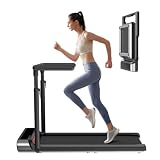 WalkingPad R3 Hybrid+ 2-in-1 TreadmillEditor's Choice Premium walk-run versatility with upright storage | Premium walk-run versatility with upright storage | View on Amazon |
Product prices and availability are accurate as of the date/time indicated and are subject to change. Any price displayed on this site at the time of purchase will govern the sale of the product. As an Amazon Associate, we earn from qualifying purchases.
Walking pad or treadmill? For most home office workers and apartment dwellers in 2026, a walking pad is the right choice. It runs quietly enough for Zoom calls, fits under any standing desk, weighs under 60 lbs, and stores flat in a closet. A traditional treadmill is the right tool only if you need to run above 4 mph or train with serious motorized incline.
Both types have their place. Here is the complete comparison so you can make the right call for your space, goals, and budget.
What is the difference between a walking pad and a treadmill?
A walking pad is a flat, motorized platform capped at 3.7–3.8 mph, weighing 40–60 lbs, running at 40–55 dB, and folding to under 5 inches for storage. A treadmill reaches 10–12 mph with motorized incline up to 15 percent, weighs 120–250 lbs, runs at 60–80 dB, and requires a permanent 70–85 × 35-inch footprint.
Quick decision guide
| Your situation | Best choice |
|---|---|
| Work from home, standing desk | Walking pad |
| Apartment or small space | Walking pad |
| Primary goal: daily step count | Walking pad |
| Budget under $400 | Walking pad |
| Need to run above 4 mph | Treadmill or 2-in-1 hybrid |
| Want motorized incline training | Treadmill |
| Weigh over 300 lbs, heavy daily use | Treadmill |
| Want both walking and occasional running | 2-in-1 hybrid |
Walking pad vs treadmill: key specs compared
| Feature | Walking Pad | Traditional Treadmill |
|---|---|---|
| Footprint in use | 55 × 21 inches | 70–85 × 35 inches |
| Storage height | Under 5 inches (flat) | 55–60 inches (folded upright) |
| Weight | 40–60 lbs | 120–250 lbs |
| Max speed | 3.7–3.8 mph (walk-only) · 7.5 mph (2-in-1 hybrids) | 10–12 mph |
| Incline | None on most models · fixed 6% on select models | 0–15% motorized |
| Belt size | 15.75–18.1 × 39–47 inches | 20–22 × 55–60 inches |
| Price range | $179–$799 | $500–$3,000+ |
| Noise level | 40–55 dB | 60–80 dB |
| Under-desk compatible | Yes — purpose-built for it | No — too tall and too loud |
| Setup time | Zero on most models | 30–60 min assembly |
The numbers make a clear case. Walking pads trade top speed and belt length for dramatic gains in portability, noise, and space efficiency. Neither type is objectively better — the right pick depends entirely on how you plan to use it.
| Walking Pad | Belt Size ↑ | Max Speed ↕ | Weight Limit ↕ | Price | Action |
|---|---|---|---|---|---|
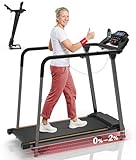 Redliro Treadmill for Seniors with Long Handrails Redliro | 14.8" x 39.3" | 5 mph | 300 lbs | View on Amazon | |
 UREVO SpaceWalk 5L Auto-Incline Walking Pad UREVO | 15.8" x 39.4" | 4 mph | 320 lbs | View on Amazon | |
 WalkingPad MX8 Vertical-Fold Treadmill WalkingPad | 15" x 39.4" | 5 mph | 330 lbs | View on Amazon | |
GoPlus 2-in-1 Folding Treadmill GoPlus | 16" x 40" | 7.5 mph | 265 lbs | View on Amazon | |
 UREVO SpaceWalk 3S Auto-Incline Walking Pad UREVO | 15" x 40.1" | 4 mph | 265 lbs | View on Amazon | |
 UREVO Strol 2E 2-in-1 Folding Treadmill UREVO | 15" x 40.2" | 6.2 mph | 265 lbs | View on Amazon | |
 Redliro Slow-Start Treadmill for Seniors (0.3 mph) Redliro | 15" x 41" | 5.5 mph | 300 lbs | View on Amazon | |
 UREVO CyberPad Auto-Incline Walking Pad UREVO | 16.5" x 42" | 4 mph | 242 lbs | View on Amazon | |
 DeerRun 4-in-1 Walking Pad DeerRun | 16.53" x 44.09" | 7.5 mph | 300 lbs | View on Amazon | |
KingSmith WalkingPad P1 KingSmith | 15.75" x 47" | 3.7 mph | 220 lbs | View on Amazon | |
WalkingPad R3 Hybrid+ 2-in-1 Treadmill WalkingPad | 17" x 47" | 7.5 mph | 265 lbs | View on Amazon | |
 WalkingPad R2 Walk & Run 2-in-1 Folding Treadmill WalkingPad | 17" x 47" | 7.5 mph | 240 lbs | View on Amazon | |
WALKINGPAD Z1 WalkingPad | 17.3" x 47.2" | 3.7 mph | 242 lbs | View on Amazon | |
 WALKINGPAD C2 Folding Walking Pad WalkingPad | 15.75" x 47.2" | 3.73 mph | 220 lbs | View on Amazon | |
 WalkingPad X21 Double-Fold Treadmill WalkingPad | 18.1" x 47.6" | 7.5 mph | 220 lbs | View on Amazon | |
 WalkingPad Z1R Foldable Walking Pad with Handlebar WalkingPad | 15.7" x 47.6" | 5 mph | 242 lbs | View on Amazon | |
 WalkingPad Z3 Just Walk Foldable Walking Pad WalkingPad | 15.7" x 47.6" | 4 mph | 242 lbs | View on Amazon | |
 LifeSpan TX6-GlowUp Under Desk Treadmill LifeSpan | 20" x 48" | 6 mph | 400 lbs | View on Amazon | |
 WalkingPad MX10 Vertical-Fold Treadmill WalkingPad | 16.1" x 48" | 6.5 mph | 265 lbs | View on Amazon |
Calorie burn: the real comparison
Treadmills burn more calories per session at high intensity — but the daily total often looks different once you account for how people actually use each machine.
| Activity | Speed | Calories/hour (155 lb person) | Typical session |
|---|---|---|---|
| Walking pad, casual desk use | 2.5 mph | ~185 cal | 60–90 min (under desk) |
| Walking pad, brisk walking | 3.5 mph | ~280 cal | 45–60 min |
| Treadmill walking | 3.5 mph | ~280 cal | 30–45 min |
| Treadmill jogging | 5.0 mph | ~480 cal | 30 min |
| Treadmill running | 6.5 mph | ~600 cal | 30 min |
The key insight: someone walking at 3.0 mph on a walking pad for 90 minutes during the workday burns 360–420 calories from that activity alone — comparable to a 30-minute jog — without carving out separate gym time. The walking pad approach is also more sustainable day-over-day because the friction to use it is near zero: it is already under your desk.
If you are a runner training for distance or time goals, a treadmill is the clear tool. If you want to move more without overhauling your schedule, a walking pad often delivers better weekly totals because the barrier to use is so low.
Noise: the most underrated spec
Noise matters more than most buyers realize until they are on a call with a treadmill running nearby.
- Walking pads: 40–55 dB at walking speeds. The WalkingPad Z1 measures below 40 dB — quieter than a normal conversation. You can take calls, watch video, and hear your own thoughts.
- Traditional treadmills: 60–80 dB under load, comparable to a vacuum cleaner (65 dB) or a busy restaurant (75 dB). The motor and belt-impact noise transfers through floors and walls.
In shared apartments and home offices, this is a practical blocker — not just a comfort preference. A 70 dB treadmill running during business hours is audible to downstairs neighbors and disruptive on video calls. A 45 dB walking pad is not.
Space planning: what each machine actually requires
These are the real measurements you need before buying.
Walking pad (WalkingPad Z1 as example):
- In use: 60.6 × 21.7 inches — roughly 9 square feet
- Folded storage: 35.8 × 21.7 × 4.7 inches (fits under a sofa or bed)
- Clearance needed behind the belt: 2–3 feet for a normal walking stride
Traditional treadmill (mid-range example):
- In use: 75 × 35 inches — roughly 18 square feet
- Folded: 40 × 35 × 60 inches, standing upright — requires permanent vertical space in a corner
- Clearance needed behind the belt: 3–4 feet per standard safety guidelines
A walking pad uses about half the floor space during use and requires no permanent footprint — it moves out of the way. A treadmill claims a corner of the room and stays there. In home offices and spare bedrooms under 200 square feet, the footprint difference is often the deciding factor.
Pros and cons of walking pads
What We Like
What Could Be Better
When should you choose a walking pad?
You want to walk while you work. This is the reason walking pads exist. Their low profile, near-silent motors, and compact footprint are engineered specifically for under-desk use. A traditional treadmill is too tall when folded (55+ inches), too loud (60–80 dB), and too wide (35 inches) to fit under a desk or run during a call. The WalkingPad Z1 runs below 40 dB with its 17.3-inch belt — see our best walking pads of 2026 for the full breakdown — and folds to under 5 inches between sessions.
You live in a smaller space. In apartments, condos, and small home offices, floor space is non-negotiable. A walking pad uses about 9 square feet during use and stores in a closet, under a bed, or behind a door. A treadmill occupies 17–20 square feet and is never compact, even when folded. If the machine needs to disappear when not in use, only a walking pad makes that practical.
You primarily walk, not run. Walking at 2.0–3.5 mph delivers well-documented health benefits. Research consistently shows that 7,000–10,000 steps per day reduces cardiovascular risk, improves mood, and supports healthy weight management. If walking is your primary form of daily movement — especially walking while you work — you do not need a machine that reaches 12 mph. For a structured interval approach, the Japanese walking method is one of the biggest fitness trends of 2026 and delivers effective cardio in 30 minutes without running.
Budget is a consideration. Walk-only walking pads span $179 to $499, well below the $500–800 floor for any quality home treadmill. The GoPlus 2-in-1 adds 7.5 mph running capability at a fraction of comparable treadmill pricing. If you are comparing a budget treadmill to the GoPlus at the same price, the GoPlus wins on motor quality, versatility, and build every time. For more options in this range, see our best walking pads under $500 guide.
When should you choose a traditional treadmill?
You need to run above 4 mph. Pure walking pads top out at 3.7–3.8 mph. If your routine includes jogging, interval sprints, or sustained running, a full-size treadmill is the right tool. Treadmills reach 10–12 mph with longer, wider belts built for running strides. If you want running at a more modest speed without a full treadmill, the 2-in-1 options below handle occasional jogging at 7.5 mph in a compact package.
You want serious incline training. Walking on incline increases calorie burn by 30–60 percent at the same speed. Most walking pads offer zero incline. A treadmill provides motorized incline up to 15 percent for hill training, HIIT programs, and calorie-intensive sessions. The walking pad market is beginning to add incline (the DeerRun 4-in-1 offers variable incline, and a few models add a fixed 6% grade), but these remain the exception. For the best incline options in the walking pad category, see our best walking pads with incline guide.
You are heavier and need maximum weight capacity. Commercial treadmills commonly reach 350–450 lbs with reinforced frames and heavy-duty decks. The highest-capacity walking pads reach 300–320 lbs — adequate for most users but trailing commercial-grade equipment. If you weigh over 300 lbs and plan intense daily use, a commercial treadmill gives more long-term confidence in the frame. For the best walking pad options for larger users, see our dedicated walking pads for heavy people guide.
You want a full-featured workout experience. Touchscreen displays, pre-programmed workout libraries, heart rate monitoring, built-in fans, and app connectivity with Apple Health or Peloton come standard on quality treadmills above $800. Walking pads keep things minimal by design — most show speed, time, and calories on a small LED panel, with some higher-end models adding Bluetooth app connectivity. If you want coached workouts and entertainment built into the machine, a full treadmill delivers it.
Is there a middle ground?
Yes — and the 2-in-1 hybrid segment is the fastest-growing category in 2026. Two models in our lineup bridge walking pads and treadmills:
GoPlus 2-in-1: best value middle ground

GoPlus 2-in-1 Folding Treadmill
by GoPlus
Best for: Running and walking versatility
Key Features
- 2.25 HP brushless motor
- Detachable handlebar for walk or run mode
Pros
- + 2-in-1 design: walking pad + treadmill with handlebar
- + 7.5 mph max speed — real running capability
Cons
- - 40-inch belt is short for tall users
- - Heavier than pure walking pads
The GoPlus converts between a flat under-desk walking pad and a full treadmill with a folding handlebar. Fold the handlebar down for under-desk walking at up to 4 mph; raise it for running at up to 7.5 mph. It is the most affordable way to have both modes in one machine. The 16 × 40-inch belt, 2.25HP brushless motor, and 265 lb weight capacity are genuinely solid at this price. For a deeper look at this category, see our best 2-in-1 walking pad treadmills roundup.
Best for: Budget buyers who want walking and running capability without committing to a full-size treadmill.
WalkingPad R2: premium middle ground
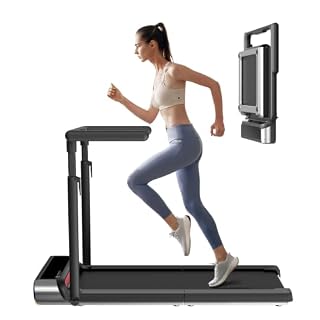
WalkingPad R3 Hybrid+ 2-in-1 Treadmill
by WalkingPad
Best for: Premium walk-run versatility with upright storage
Key Features
- Brushless motor, 0.5-7.5 mph (4 mph in under-desk mode, up to 7.5 mph with handrail raised)
- 2-in-1: lower the height-adjustable handrail to walk under a desk, raise it to run
Pros
- + Genuine walk-and-run: 4 mph under-desk mode, 7.5 mph with the handrail raised
- + Double-folds and stores upright — minimal storage footprint
Cons
- - Premium price point
- - Heavier than walk-only pads
Heads up: the WalkingPad R2 has been discontinued — KingSmith replaced it with the newer WalkingPad R3 Hybrid+, which is the model we now recommend. The R3 is the most premium middle-ground machine in our lineup and the direct upgrade from the R2 (and from the older A1 Pro). Lower the height-adjustable handrail and it works as a spacious under-desk walking pad at about 4 mph with the same proven 17 × 47-inch belt as the R2. Raise the handrail and it runs like a proper treadmill at up to 7.5 mph on a one-piece aluminum-alloy frame that does not flex under load, with dual side handrails for stability and a 265 lb weight capacity. The double-fold design stores upright against the wall — the smallest storage footprint of any running-capable machine on our list — and the KS Fit app plus LED display track steps, speed, time, and distance. It sits well below the $800–1,200 floor for comparable traditional treadmills. It is a newer listing, but it is live, buyable, and backed by KingSmith's established R-series track record (unlike the R2, which is no longer sold).
Best for: Users who want genuine running capability on a machine that stores vertically against the wall, without paying full treadmill prices.
A different kind of middle ground: handrail treadmills for stability
Not every middle-ground buyer wants more running speed — some want more support instead. Redliro sells two treadmills built around full-length or dual handrails rather than a short detachable bar, aimed at seniors and recovery walkers who prioritize stability over compactness or running capability. They are not flat walking pads and are not designed to slide under a desk, but if handrail support at controlled walking speeds is the actual goal, they fill a gap that neither a pure walking pad nor a running-focused 2-in-1 covers. See our full Redliro walking pad guide for the honest breakdown of both models.
How to decide: four questions
Work through these in order:
- Will you primarily walk or run? Walking only — choose a pure walking pad (Z1 or P1). Occasional running — GoPlus 2-in-1. Serious running in a compact machine — the WalkingPad R3 Hybrid+ (the successor that replaced the discontinued R2).
- Where will you use it? Under a desk or in a small room — walking pad. Dedicated home gym with space — traditional treadmill.
- What is your budget? Under $400 — walking pad territory. $400–$700 — premium 2-in-1. $700+ — true treadmill options open up.
- How important is storage? Must disappear when not in use — only a walking pad is practical.
For most people setting up a home office walking station in 2026, a walking pad delivers everything they need at a fraction of the cost and space of a treadmill. The exceptions are runners who need speeds above 7.5 mph, users who require steep motorized incline, or those who want a full-gym experience at home.
How to Compare Current Prices
Compare machines that solve the same job. A walk-only under-desk pad should not be price-compared directly with a full running treadmill unless both actually meet your speed, belt, and storage requirements.
Our walking pad deals and current-price page shows the latest available feed for in-stock walking pads. For traditional treadmills, compare the exact model and warranty terms at the retailer before ordering.
Our recommendations
For pure under-desk walking, the WalkingPad Z1 offers the widest and longest belt in its class (17.3 × 47.2 inches), runs below 40 dB, and folds to under 5 inches.

WALKINGPAD Z1
by WalkingPad
Best for: Widest belt and longest stride at mid-range price
Key Features
- 0.75 HP brushless motor (continuous duty)
- Industry-leading belt width at 17.3 inches
Pros
- + Widest belt at 17.3 inches — most spacious feel
- + 47.2-inch length matches premium models
Cons
- - Walking only — 3.7 mph max
- - Smaller motor at 0.75 HP
The KingSmith P1 is a close alternative with a 47-inch belt and proven KingSmith reliability.

KingSmith WalkingPad P1
by KingSmith
Best for: Budget-conscious tall users
Key Features
- 1 HP brush motor
- Nearly as long as A1 Pro at a lower price
Pros
- + 47-inch belt nearly matches the A1 Pro
- + Significantly cheaper than A1 Pro
Cons
- - Brush motor is louder than brushless A1 Pro
- - Slightly narrower belt at 15.75 inches
For occasional running on a budget, the GoPlus 2-in-1 is the clear value pick. For serious walkers who also want genuine running capability in a compact, premium machine, the WalkingPad R3 Hybrid+ (the successor that replaced the discontinued R2) is the best middle-ground option in our lineup.
For the full lineup with all specs, pricing, and category winners, see our best walking pads of 2026 guide. If you are taller or have a longer stride, the walking pad belt size guide explains exactly how to match belt dimensions to your height and shoe size. For the home office setup beyond just the machine, see our walking pad WFH desk setup guide.
TheBestWalkingPads.com is a participant in the Amazon Services LLC Associates Program. We earn a small commission on qualifying purchases at no extra cost to you.