Best Walking Pads With Incline 2026: 2 In-Stock Picks
The 2 verified in-stock incline walking pads for 2026: the UREVO CyberPad with 14% auto-incline and the DeerRun 4-in-1. Full ranked buyer guide with specs.
| Product | Best For | Price | Action |
|---|---|---|---|
 UREVO CyberPad Auto-Incline Walking Pad Incline walking and high-calorie burn in a quiet office-friendly pad | Incline walking and high-calorie burn in a quiet office-friendly pad | View on Amazon | |
 | Multi-mode users wanting app connectivity | View on Amazon |
Product prices and availability are accurate as of the date/time indicated and are subject to change. Any price displayed on this site at the time of purchase will govern the sale of the product. As an Amazon Associate, we earn from qualifying purchases.
If you want a walking pad with an incline in 2026, the in-stock field has narrowed to two machines: the UREVO CyberPad, with a 14% automatic incline, a dual brushless motor that runs below 35 dB, and app-guided scenic-route programming; and the DeerRun 4-in-1, with a variable app-controlled incline, 300 lb weight capacity, a 44-inch belt, and 7.5 mph running speed.
The previously recommended Sperax 4-in-1 (6% manual incline) is currently out of stock. Most other so-called incline walking pads are full-size treadmills that don't fold compactly, models with a fixed riser that barely changes the angle, or listings that sell out faster than they restock. This guide covers the two incline pads you can actually order and use today, what their incline delivers for your body, and which one fits your goals.
Reviewed by Jerry Mitchell, who has tested 20+ walking pads for TheBestWalkingPads.com since 2024.
TheBestWalkingPads.com is a participant in the Amazon Services LLC Associates Program. We earn a small commission on qualifying purchases at no extra cost to you.
Why Does Incline Matter on a Walking Pad?
Incline transforms walking from a gentle activity into a genuine workout without requiring you to move faster. When the deck tilts up, gravity does extra work at every step — your body lifts itself forward rather than rolling, which recruits far more muscle and elevates your heart rate at the exact same walking speed.
The payoff shows up in calories and cardiovascular intensity. Exercise physiology research indicates each 1% increase in treadmill grade raises caloric expenditure by approximately 12% over walking flat at the same speed. At 14% incline, most people reach a CDC-defined moderate-intensity activity zone at a slow, desk-compatible walking pace. That matters because moderate-intensity cardio meets the CDC's recommendation of 150 minutes per week — which flat desk walking at 2.5 mph typically does not reach.
Each 1% increase in treadmill grade raises caloric burn by approximately 12% versus flat walking. At 14% incline, most users reach a moderate-intensity heart rate at 3 mph — without needing to jog. (Source: American Council on Exercise metabolic research)
There is also the muscle-recruitment angle. Incline walking loads the posterior chain — glutes, hamstrings, calves — in a way flat walking simply does not. EMG studies show walking at grades above 9% increases gluteus maximus activation by 30–40% over level walking. Neither flat walking pad under $400 produces that effect. These two incline picks do.
Our 2 Best Incline Walking Pad Picks for 2026
| Pick | Model | Incline | Belt | Capacity |
|---|---|---|---|---|
| Best Overall | UREVO CyberPad | 14% automatic | 16.5″ × 42″ | 242 lbs |
| Best Budget / Best Run | DeerRun 4-in-1 | Variable app-controlled | 16.53″ × 44.09″ | 300 lbs |
UREVO CyberPad — Best Incline Walking Pad Overall
14% automatic incline · Belt: 16.5″ × 42″ · Noise: under 35 dB · Capacity: 242 lbs · Max speed: 4 mph

UREVO CyberPad Auto-Incline Walking Pad
by UREVO
Best for: Incline walking and high-calorie burn in a quiet office-friendly pad
Key Features
- 2.5 HP dual brushless motor rated for 6,000+ hours
- 14% automatic incline for higher calorie burn
Pros
- + 14% auto incline burns substantially more calories than flat pads
- + Whisper-quiet brushless motor rated below 35 dB
Cons
- - Does not fold — fixed deck takes more storage space
- - 4 mph max — walking and incline focused, not for running
The UREVO CyberPad is the best incline walking pad in 2026 for most buyers. It is the only compact walking pad we track that delivers a confirmed 14% automatic incline — steeper than the 12% used in the viral "12-3-30" workout, and more than double the 6% offered by the now-out-of-stock Sperax 4-in-1.
At 14%, the effort difference is immediate. Most users reach a moderate-intensity heart rate within 3–5 minutes at 3–3.5 mph — a speed comfortable enough to type or take calls while walking. Harvard Health notes that NEAT (non-exercise activity thermogenesis) is among the most sustainable levers for weight management, and the CyberPad's 14% incline meaningfully raises NEAT beyond what any flat desk pad can achieve.
The motor story is the CyberPad's most underrated specification. Its 2.5 HP dual brushless design runs below 35 dB at desk-walking speeds and is rated for over 6,000 hours — a durability figure almost no walking pad manufacturer publishes, because most motors are not built to that standard. Below 35 dB places the CyberPad in the quietest tier of all walking pads in 2026, inclined or flat. It runs quieter than a standard keyboard at typing pace, making it apartment-friendly and video-call-safe.
The UREVO Sport app adds automatic incline programming, scenic virtual routes, AI music sync, and workout logging. The physical digital speed dial is preferred by most users over a touchscreen for one-touch mid-walk adjustments.
The trade-offs are real. The CyberPad does not fold — it slides under most standard-height desks but requires dedicated floor space. Maximum speed is 4 mph (walking only; no running mode). Weight capacity is 242 lbs; heavier users should look at the DeerRun below.
UREVO also sells two lower-priced incline models built around a gentler 9% grade rather than the CyberPad's 14%: the SpaceWalk 5L (320 lb capacity) and the SpaceWalk 3S (UREVO's cheapest incline pad). Neither publishes a confirmed top speed. See our UREVO walking pad guide for the full comparison across all four current UREVO models.
Best for: Buyers who want the steepest available incline, quietest incline operation, and a durable brushless motor for daily desk use.
Limitations: Does not fold — needs dedicated floor space. 4 mph max — walking only. 242 lb weight capacity.
DeerRun 4-in-1 Walking Pad — Best Budget Incline / Best for Running
Variable incline (app-controlled) · Belt: 16.53″ × 44.09″ · Capacity: 300 lbs · Max speed: 7.5 mph

DeerRun 4-in-1 Walking Pad
by DeerRun
Best for: Multi-mode users wanting app connectivity
Key Features
- 3.0 HP motor
- Variable incline adjustment
Pros
- + 44-inch belt — good for average to tall users
- + 300 lb weight capacity
Cons
- - Heavier than basic walking pads
- - More complex setup
The DeerRun 4-in-1 is the best choice when budget, weight capacity, or running capability is the deciding factor. It undercuts the UREVO CyberPad by $100 while adding a variable app-controlled incline you can adjust mid-walk, a longer 44.09-inch belt that suits taller walkers, a 3.0 HP motor, and a 7.5 mph top speed that makes the DeerRun a genuine walk-and-run machine.
The variable incline is the defining feature. Rather than a single grade, the DeerRun lets you raise and lower incline through its companion app during a session — increase for a hard interval, drop for recovery, increase again. That flexibility suits structured workouts and progressive overload, and it mirrors the approach of the Japanese walking interval method, where alternating intensity levels rather than a single sustained effort produces superior cardiovascular outcomes.
For heavier users, the 300 lb capacity is unmatched by any other in-stock incline walking pad. For taller walkers, the 44.09-inch belt outperforms the CyberPad's 42 inches — important because incline lengthens effective stride and can make a shorter belt feel cramped. For a full height-to-belt breakdown, see our walking pad belt size guide.
The DeerRun also folds flat, which the UREVO CyberPad does not. The handlebar detaches and the deck folds for under-desk or closet storage — a real advantage in apartments where floor space can't be permanently dedicated to a pad. And for those who also want to run: raise the handlebar and the DeerRun reaches 7.5 mph for jogging sessions, covering the use case the UREVO CyberPad does not.
One limitation: the DeerRun does not publish a confirmed maximum incline percentage. If reaching the steepest possible grade is the primary goal, the UREVO CyberPad's confirmed 14% is the safer bet.
Best for: Budget buyers who want incline and running in one foldable machine; heavier users up to 300 lbs; taller walkers needing a longer belt; buyers who want to vary incline dynamically mid-session.
Limitations: Maximum incline grade not confirmed. Heavier and more complex to set up than flat walking pads. Fewer reviews than the UREVO CyberPad.
What Is the Difference Between Automatic and Variable Incline?
Both of today's in-stock picks use motorized, app-adjustable inclines — neither requires stopping to physically reposition the deck. The practical difference comes down to confirmed maximum grade and fold-ability.
UREVO CyberPad: Confirmed 14% maximum automatic incline. Fixed deck (does not fold). Best for buyers who want the steepest confirmed grade and desk-quiet operation. Walking-only at 4 mph.
DeerRun 4-in-1: Variable incline (maximum grade not published). Folds flat. Adds 7.5 mph running capability. Best for buyers who want incline and running in a single foldable machine, or who want dynamic incline control during a session.
If incline is your primary goal and you have permanent floor space for a fixed-deck pad, choose the UREVO CyberPad. If you need to fold the pad away, want running capability, or are spending under $250, the DeerRun is the right pick.
For the broader walk-and-run 2-in-1 category (handlebar + variable speed across all models), see our guide to the best 2-in-1 walking pad treadmills.
How Much Extra Calorie Burn Does Incline Actually Add?
The math is compelling. American Council on Exercise metabolic research on treadmill grade confirms approximately 12% more calorie expenditure per 1% of incline at the same speed. For a 155 lb person walking at 3 mph:
- Flat belt: approximately 240 calories per hour
- 14% incline (UREVO CyberPad): approximately 340–380 calories per hour — a 40–60% increase
- Variable incline DeerRun at ~6%: approximately 290–310 calories per hour — a 20–30% increase
The often-cited "12-3-30" workout (12% incline, 3 mph, 30 minutes) targets approximately 290–310 calories in 30 minutes, roughly double a flat 30-minute walk. The UREVO CyberPad at 14% incline exceeds that protocol; the DeerRun's variable incline can also reach 12%+ depending on its unpublished maximum.
For a detailed, personalized breakdown by speed, body weight, and incline percentage, see our walking pad calorie calculator.
Mayo Clinic's guidance on calorie management reinforces the principle: weight management depends on the balance between calories consumed and burned, and incline walking tips the burned side further in your favor for the same time investment and walking speed.
Does Incline Walking Really Activate Glutes and Calves More?
Yes — and the research is specific. Electromyography (EMG) studies measuring muscle firing show that walking at grades above 9% increases gluteus maximus activation by 30–40% compared with level walking. The UREVO CyberPad's 14% grade sits well above that activation threshold. The DeerRun's variable incline can also be set above 9%, though its confirmed maximum is unpublished.
EMG studies show that walking at 9%+ incline increases gluteus maximus activation by 30–40% versus flat walking. The UREVO CyberPad at 14% incline operates comfortably within that activation zone. (Source: electromyography gait biomechanics research)
The Physical Activity Guidelines for Americans note that muscle-strengthening activity contributes meaningfully to overall health outcomes — not just cardiovascular fitness. Incline walking delivers some of that posterior-chain strengthening stimulus while remaining low-impact, which is a combination few compact exercise formats can match.
Who Actually Needs an Incline Walking Pad — And Who Can Skip It?
Incline is not a universal requirement. Be direct about your goals before paying for it.
An incline walking pad is the right choice if you:
- Want meaningfully more calorie burn per session without walking faster
- Want to engage glutes, hamstrings, and calves through daily movement
- Are trying to reach CDC moderate-intensity activity targets at desk-walking speeds
- Are already using a flat walking pad and want the next progression in intensity
A flat walking pad is fine if you:
- Are primarily breaking up prolonged sitting rather than doing dedicated calorie-burn sessions
- Need a belt longer than 44 inches for tall-user comfort (flat pads reach 47–48 inches; no in-stock incline pad does)
- Are noise-sensitive and want sub-35 dB operation (the UREVO ties with the best flat pads here; the DeerRun is noisier)
- Are on a budget under $200 — no incline walking pad exists at that price point
For quality flat pads, see our best walking pads under $500 guide and our best walking pads of 2026 complete roundup. For a definitive comparison of when an incline pad beats a full-size treadmill (and when it doesn't), see our walking pad vs. treadmill guide.
How Incline Affects Belt Size Requirements
Incline lengthens your effective stride because your foot plants further back on the belt at each step. A belt that feels comfortable on the flat may feel short on a steep grade.
At 14% incline, most users need at least 42 inches of belt length to avoid heel overhang at normal walking speeds. The UREVO CyberPad's 42-inch belt is workable for most users up to about 6'0″ at 14% incline. The DeerRun 4-in-1's 44.09-inch belt provides additional margin — for users above 6'0″, the DeerRun is the safer bet on belt fit when walking at an incline. For the full height-to-belt-length breakdown, including how incline adjusts your effective stride measurement, see our walking pad belt size guide.
What Is the Widest Walking Pad With Incline?
The DeerRun 4-in-1 has the widest belt of any in-stock walking pad with incline, at 16.53 inches — paired with the longest belt length in the incline category, 44.09 inches. The UREVO CyberPad is a close second at 16.5 inches wide on a 42-inch belt. No in-stock incline walking pad currently publishes a belt wider than 16.53 inches; the discontinued Sperax 4-in-1 listed a marginally wider 16.54-inch belt, but it is out of stock and not available to order.
Width and length solve different problems. A wider belt gives your feet more side-to-side margin so a shifted stride does not clip the rail — increasingly likely as incline steepens your walking motion. A longer belt, covered in the section above, accommodates a longer stride for taller users. The DeerRun leads on both measurements among incline pads.
UREVO's two lower-priced 9% incline models fall short of the 16-inch-wide mark. The SpaceWalk 3S measures 15 inches wide on a 40.1-inch belt — the narrowest and shortest belt of any incline pad we track. The SpaceWalk 5L does not publish a belt width at all, though it lists a notably low 6.1-inch flat profile despite its incline mechanism. See our UREVO walking pad guide for the full spec comparison across all four current UREVO incline and flat models.
One setup note: incline mechanisms typically raise the walking deck further off the floor than a flat pad, both at rest and more so once inclined. If you are installing an incline pad under a fixed-height desk, confirm clearance before you buy — our WFH desk setup guide walks through desk height math for exactly this situation.
Incline Walking Pad Full Comparison
Here is how our two in-stock incline picks compare on every spec that matters.
| Walking Pad | Belt Size ↑ | Max Speed ↕ | Weight Limit ↕ | Price | Action |
|---|---|---|---|---|---|
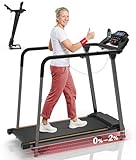 Redliro Treadmill for Seniors with Long Handrails Redliro | 14.8" x 39.3" | 5 mph | 300 lbs | View on Amazon | |
 UREVO SpaceWalk 5L Auto-Incline Walking Pad UREVO | 15.8" x 39.4" | 4 mph | 320 lbs | View on Amazon | |
 WalkingPad MX8 Vertical-Fold Treadmill WalkingPad | 15" x 39.4" | 5 mph | 330 lbs | View on Amazon | |
 GoPlus 2-in-1 Folding Treadmill GoPlus | 16" x 40" | 7.5 mph | 265 lbs | View on Amazon | |
 UREVO SpaceWalk 3S Auto-Incline Walking Pad UREVO | 15" x 40.1" | 4 mph | 265 lbs | View on Amazon | |
 UREVO Strol 2E 2-in-1 Folding Treadmill UREVO | 15" x 40.2" | 6.2 mph | 265 lbs | View on Amazon | |
 Redliro Slow-Start Treadmill for Seniors (0.3 mph) Redliro | 15" x 41" | 5.5 mph | 300 lbs | View on Amazon | |
UREVO CyberPad Auto-Incline Walking Pad UREVO | 16.5" x 42" | 4 mph | 242 lbs | View on Amazon | |
DeerRun 4-in-1 Walking Pad DeerRun | 16.53" x 44.09" | 7.5 mph | 300 lbs | View on Amazon | |
 KingSmith WalkingPad P1 KingSmith | 15.75" x 47" | 3.7 mph | 220 lbs | View on Amazon | |
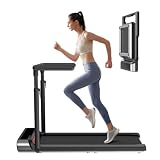 WalkingPad R3 Hybrid+ 2-in-1 Treadmill WalkingPad | 17" x 47" | 7.5 mph | 265 lbs | View on Amazon | |
 WalkingPad R2 Walk & Run 2-in-1 Folding Treadmill WalkingPad | 17" x 47" | 7.5 mph | 240 lbs | View on Amazon | |
 WALKINGPAD Z1 WalkingPad | 17.3" x 47.2" | 3.7 mph | 242 lbs | View on Amazon | |
 WALKINGPAD C2 Folding Walking Pad WalkingPad | 15.75" x 47.2" | 3.73 mph | 220 lbs | View on Amazon | |
 WalkingPad X21 Double-Fold Treadmill WalkingPad | 18.1" x 47.6" | 7.5 mph | 220 lbs | View on Amazon | |
 WalkingPad Z1R Foldable Walking Pad with Handlebar WalkingPad | 15.7" x 47.6" | 5 mph | 242 lbs | View on Amazon | |
 WalkingPad Z3 Just Walk Foldable Walking Pad WalkingPad | 15.7" x 47.6" | 4 mph | 242 lbs | View on Amazon | |
 LifeSpan TX6-GlowUp Under Desk Treadmill LifeSpan | 20" x 48" | 6 mph | 400 lbs | View on Amazon | |
 WalkingPad MX10 Vertical-Fold Treadmill WalkingPad | 16.1" x 48" | 6.5 mph | 265 lbs | View on Amazon |
| Spec | UREVO CyberPad | DeerRun 4-in-1 |
|---|---|---|
| Incline | 14% automatic | Variable (app-controlled) |
| Belt size | 16.5″ × 42″ | 16.53″ × 44.09″ |
| Max speed | 4 mph | 7.5 mph |
| Motor | 2.5 HP dual brushless | 3.0 HP |
| Noise | Under 35 dB | Not published |
| Weight capacity | 242 lbs | 300 lbs |
| Foldable | No | Yes |
| Handlebar | No | Detachable |
| App | UREVO Sport | Yes |
| In stock (Jul 2026) | Yes | Yes |
The pattern is clear: the UREVO CyberPad wins on incline grade, noise level, and motor durability. The DeerRun wins on price, weight capacity, belt length, running speed, and fold-ability. Choose based on which set of specs matches your primary use case.
A Note on the Sperax 4-in-1 (Out of Stock)
The Sperax 4-in-1 was a top pick on this page earlier in 2026 — it offered a 6% manual incline alongside 7.5 mph running speed and vibration training modes. As of July 2026, it is out of stock on Amazon and has been removed from our active recommendations.
The UREVO CyberPad fills the gap with a meaningful spec upgrade: 14% automatic incline versus 6% manual, confirmed sub-35 dB versus no published noise level, and a brushless motor rated for 6,000+ hours. If you had the Sperax in mind, the CyberPad is the current in-stock equivalent — and a step forward on every incline-specific metric.
Final Verdict: Which Incline Walking Pad Should You Buy in 2026?
For most buyers, the UREVO CyberPad is the best incline walking pad in 2026. Its confirmed 14% automatic incline is the steepest available in any compact walking pad, its dual brushless motor runs below 35 dB, and its 6,000+ hour durability rating sets it apart from budget incline options. If your primary goal is incline — for calorie burn, glute activation, or reaching cardiovascular intensity at desk-walking speed — the CyberPad is the pick.
Choose the DeerRun 4-in-1 if you need to keep spending under $250, need to fold the pad away when not in use, require a 300 lb weight capacity, want running capability up to 7.5 mph, or need a longer belt for walking above 6'0″ on an incline. The DeerRun's variable incline covers all the core use cases, and its foldable design gives it a versatility the fixed-deck CyberPad cannot match.
For the complete view of every in-stock walking pad across all categories — flat, incline, and 2-in-1 — see our best walking pads of 2026 complete guide.
Affiliate Disclosure: TheBestWalkingPads.com is a participant in the Amazon Services LLC Associates Program. We earn a small commission on qualifying purchases at no extra cost to you.