Walking Pad Width & Belt Size Guide for Every Height
Learn how to choose the right walking pad width and belt length for your height and stride, plus who really needs a 20-inch belt. Find your ideal fit today.
| Product | Best For | Price | Action |
|---|---|---|---|
 | Widest belt and longest stride at mid-range price | View on Amazon | |
 | Budget-conscious tall users | View on Amazon | |
 | Running and walking versatility | View on Amazon | |
 LifeSpan TX6-GlowUp Under Desk Treadmill Heavy users, long workdays, and office professionals wanting a maintenance-free premium under-desk treadmill | Heavy users, long workdays, and office professionals wanting a maintenance-free premium under-desk treadmill | View on Amazon |
Product prices and availability are accurate as of the date/time indicated and are subject to change. Any price displayed on this site at the time of purchase will govern the sale of the product. As an Amazon Associate, we earn from qualifying purchases.
Walking pad belt size is one of the most overlooked factors when shopping for an under-desk treadmill. Most buyers focus on price, speed, and noise level, then end up disappointed when their feet feel cramped or their stride feels artificially shortened. Getting the belt dimensions right from the start makes the difference between a walking pad you use every day and one that collects dust in a closet.
This guide breaks down exactly how belt width and length affect your walking experience, with specific size recommendations based on your height.
Why Does Walking Pad Belt Size Matter?
The belt is your entire walking surface. Every step lands on it, and if the dimensions do not match your body, you will feel it within minutes.
Belt length determines your stride. A healthy walking stride for an average-height adult covers roughly 24 to 30 inches per step. The belt needs to be long enough to accommodate your full stride without forcing you to shorten your steps or walk unnaturally close to the front edge. When a belt is too short, you unconsciously shorten your gait, which shifts stress to your knees and reduces the calorie-burning efficiency of your walk.
Belt width determines your lateral comfort. Your feet naturally land with some variation in horizontal placement, especially during longer walking sessions when fatigue sets in. A belt that is too narrow forces you to concentrate on foot placement instead of your work or entertainment. Over time, this creates tension in your hips and ankles as your body compensates to stay centered.
What Belt Length Do You Need Based on Your Height?
Belt length is the more critical of the two dimensions. Here are the recommended minimums based on height:
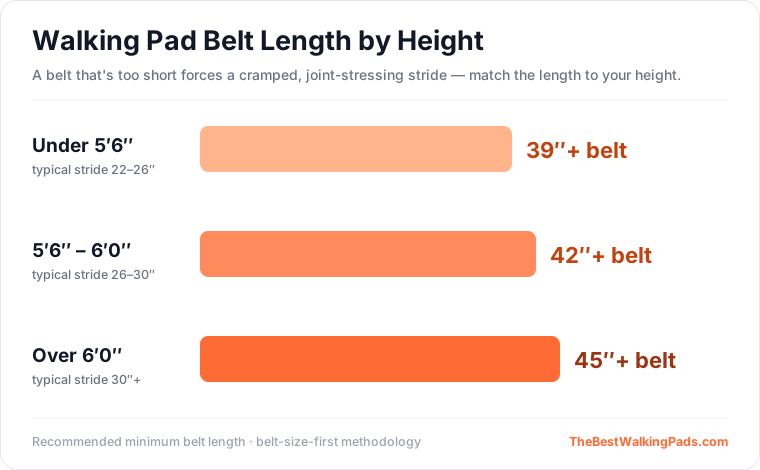
Under 5 feet 6 inches
A belt length of 39 inches or longer works well. At this height range, your natural walking stride is typically 22 to 26 inches, which fits comfortably on shorter belt surfaces. Most budget walking pads in the 39 to 41-inch range will feel spacious. The UREVO Strol 2E (15x40.2-inch belt) is a current compact example.
5 feet 6 inches to 6 feet tall
Look for a belt length of 42 inches or longer. Your stride at a comfortable walking pace averages 26 to 30 inches, and you need extra belt length as a buffer. A 40-inch belt can work at slower speeds under 2.5 mph, but you will feel constrained if you pick up the pace. The GoPlus 2-in-1 (16x40-inch belt) works at the lower end of this range, while the KingSmith P1 (15.75x47-inch belt) provides generous length for taller users in this group.
Over 6 feet tall
Choose a belt that is 45 inches or longer. Tall walkers have strides that regularly exceed 30 inches, and anything under 44 inches can feel cramped at normal walking speeds. The WALKINGPAD Z1 (17.3x47.2-inch belt), KingSmith P1 (15.75x47-inch belt), and LifeSpan TX6 (20x48-inch belt) all provide the length needed for a more natural stride.
How Wide Should Your Walking Pad Belt Be?
Belt width on current walking pads spans roughly 15 to 20 inches. Here is how each category feels in practice:
- 15 to 15.75 inches -- Compact. Works for focused, slower walking while keeping the footprint small. The UREVO Strol 2E uses a 15-inch belt; the KingSmith P1 uses 15.75 inches.
- 16 to 16.5 inches -- Standard to roomy. This range gives most walkers adequate lateral space without making the pad difficult to store. The GoPlus 2-in-1 uses 16 inches.
- 17 inches and wider -- Extra room. The WALKINGPAD Z1 uses a 17.3-inch belt, while the premium LifeSpan TX6 reaches 20 inches for users who prioritize stability and a wider gait.
How Wide Is a Walking Pad?
Walking pad belt width typically falls between 15 and 20 inches, although compact under-desk models cluster near 15 to 16 inches. A narrower belt keeps the machine lighter and easier to slide under a desk, but leaves less margin for natural side-to-side foot placement. A wider option such as the 17.3-inch WALKINGPAD Z1 gives your feet more forgiving room during longer sessions and faster paces, at the cost of a larger footprint. Our tall-walker guide compares the longer and wider options. For typical desk-side walking at 1 to 3 mph, 16 to 17 inches is comfortable for most people; 20 inches is mainly useful for a wide gait or premium all-day setup.
What Is the Standard Treadmill Belt Width?
Standard walking pad belts run 15 to 17 inches wide -- narrow enough to slide under a desk without eating up floor space. Full-size treadmills built for running use noticeably wider belts, typically 18 to 22 inches, because a running stride needs more lateral clearance than a walking stride does. Current examples span the KingSmith P1's 15.75-inch belt, the GoPlus 2-in-1's 16-inch belt, and the WALKINGPAD Z1's 17.3-inch belt. The LifeSpan TX6 is an unusually wide under-desk option at 20 inches.
How Do All Walking Pads Compare on Belt Size?
Here is a side-by-side look at belt dimensions across the current market:
| Walking Pad | Belt Size ↑ | Max Speed ↕ | Weight Limit ↕ | Price | Action |
|---|---|---|---|---|---|
 Redliro Treadmill for Seniors with Long Handrails Redliro | 14.8" x 39.3" | 5 mph | 300 lbs | View on Amazon | |
 UREVO SpaceWalk 5L Auto-Incline Walking Pad UREVO | 15.8" x 39.4" | 4 mph | 320 lbs | View on Amazon | |
 WalkingPad MX8 Vertical-Fold Treadmill WalkingPad | 15" x 39.4" | 5 mph | 330 lbs | View on Amazon | |
GoPlus 2-in-1 Folding Treadmill GoPlus | 16" x 40" | 7.5 mph | 265 lbs | View on Amazon | |
 UREVO SpaceWalk 3S Auto-Incline Walking Pad UREVO | 15" x 40.1" | 4 mph | 265 lbs | View on Amazon | |
 UREVO Strol 2E 2-in-1 Folding Treadmill UREVO | 15" x 40.2" | 6.2 mph | 265 lbs | View on Amazon | |
 Redliro Slow-Start Treadmill for Seniors (0.3 mph) Redliro | 15" x 41" | 5.5 mph | 300 lbs | View on Amazon | |
 UREVO CyberPad Auto-Incline Walking Pad UREVO | 16.5" x 42" | 4 mph | 242 lbs | View on Amazon | |
 DeerRun 4-in-1 Walking Pad DeerRun | 16.53" x 44.09" | 7.5 mph | 300 lbs | View on Amazon | |
KingSmith WalkingPad P1 KingSmith | 15.75" x 47" | 3.7 mph | 220 lbs | View on Amazon | |
 WalkingPad R3 Hybrid+ 2-in-1 Treadmill WalkingPad | 17" x 47" | 7.5 mph | 265 lbs | View on Amazon | |
 WalkingPad R2 Walk & Run 2-in-1 Folding Treadmill WalkingPad | 17" x 47" | 7.5 mph | 240 lbs | View on Amazon | |
WALKINGPAD Z1 WalkingPad | 17.3" x 47.2" | 3.7 mph | 242 lbs | View on Amazon | |
 WALKINGPAD C2 Folding Walking Pad WalkingPad | 15.75" x 47.2" | 3.73 mph | 220 lbs | View on Amazon | |
 WalkingPad X21 Double-Fold Treadmill WalkingPad | 18.1" x 47.6" | 7.5 mph | 220 lbs | View on Amazon | |
 WalkingPad Z1R Foldable Walking Pad with Handlebar WalkingPad | 15.7" x 47.6" | 5 mph | 242 lbs | View on Amazon | |
 WalkingPad Z3 Just Walk Foldable Walking Pad WalkingPad | 15.7" x 47.6" | 4 mph | 242 lbs | View on Amazon | |
LifeSpan TX6-GlowUp Under Desk Treadmill LifeSpan | 20" x 48" | 6 mph | 400 lbs | View on Amazon | |
 WalkingPad MX10 Vertical-Fold Treadmill WalkingPad | 16.1" x 48" | 6.5 mph | 265 lbs | View on Amazon |
What Belt Size Should You Choose for Under-Desk Walking?
Under-desk use introduces a unique consideration: you are walking while working, which means your attention is divided. When you are focused on a screen or a phone call, your foot placement becomes less precise. For under-desk walking, err on the side of a wider belt.
A minimum of 16 inches wide and 40 inches long keeps most people comfortable while multitasking at speeds of 1.5 to 2.5 mph. If you walk faster than 3 mph while working or if you are taller than 5 feet 10 inches, step up to a 16.5-inch wide belt that is at least 47 inches long.
The investment in a properly sized belt pays off over months and years of daily use. A walking pad that fits your body keeps you walking longer, more comfortably, and with less risk of strain or missteps.