Quietest Walking Pads for Apartments 2026: Ranked by dB
The quietest walking pads for apartment living in 2026, ranked by verified decibel levels — under-desk treadmills that will not disturb your neighbors.
| Product | Best For | Price | Action |
|---|---|---|---|
 UREVO CyberPad Auto-Incline Walking Pad Incline walking and high-calorie burn in a quiet office-friendly pad | Incline walking and high-calorie burn in a quiet office-friendly pad | View on Amazon | |
 | Widest belt and longest stride at mid-range price | View on Amazon | |
 | Budget-conscious tall users | View on Amazon | |
 WALKINGPAD C2 Folding Walking Pad Budget-conscious walkers who want a long belt | Budget-conscious walkers who want a long belt | View on Amazon | |
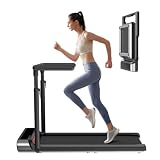 WalkingPad R3 Hybrid+ 2-in-1 TreadmillEditor's Choice Premium walk-run versatility with upright storage | Premium walk-run versatility with upright storage | View on Amazon |
Product prices and availability are accurate as of the date/time indicated and are subject to change. Any price displayed on this site at the time of purchase will govern the sale of the product. As an Amazon Associate, we earn from qualifying purchases.
If you live in an apartment, you already know the math: sound travels. Dropping a pan in the kitchen, rolling a chair across hardwood floors, running the vacuum after 9 PM — all of it carries. Adding a walking pad means choosing carefully. The wrong model is loud enough to hear through walls at 3 mph. The right model disappears into the background while you work.
The short answer: a new quieter option has entered the lineup. The UREVO CyberPad is now the quietest verified walking pad at under 35 dB — quieter than a library reading room. For most apartment buyers, though, the WALKINGPAD Z1 at 40 dB remains the best value: it matches the discontinued A1 Pro on noise, beats it on belt width (17.3 vs 16.5 inches), and costs $200 less. All five picks below are verified in stock as of June 2026.
Availability update (June 2026): The KingSmith A1 Pro and Citysports Under-Desk Treadmill — previously the two most popular quiet picks — are both out of stock on Amazon with no confirmed restock dates. The five walking pads on this page are verified in-stock replacements. If you were looking for the A1 Pro, see our full A1 Pro alternatives guide for a complete comparison.
Quick picks:
- Quietest verified (35 dB): UREVO CyberPad — 14% auto-incline, brushless motor, walks silently
- Best value quiet (40 dB): WALKINGPAD Z1 — widest belt in its price range, folds flat
- Editor's Choice, long belt: KingSmith P1 — 47-inch belt, brushless-lineage motor
- Long belt, flat-fold: WALKINGPAD C2 — 47.2-inch belt, footstep induction speed
- Premium quiet + running: WalkingPad R3 Hybrid+ — walks quietly to 4 mph, runs to 7.5 mph, double-fold upright storage
TheBestWalkingPads.com is a participant in the Amazon Services LLC Associates Program. We earn a small commission on qualifying purchases at no extra cost to you.
How Loud Are Walking Pads, Really?
Decibels are logarithmic: every 10 dB increase represents roughly double the perceived loudness to human ears. Here is what the scale means for apartment walkers:
| Sound | Approximate dB |
|---|---|
| UREVO CyberPad (walking mode) | 35 dB |
| Library reading room | 35–40 dB |
| WALKINGPAD Z1 | 40 dB |
| Refrigerator hum | 40 dB |
| Quiet conversation | 55 dB |
| Dishwasher | 60 dB |
| Normal conversation | 65 dB |
The gap between 35 dB and 55 dB is significant in practice — the louder unit is more than three times as loud to your ears. The WHO Environmental Noise Guidelines recommend indoor noise levels below 35 dB for undisturbed indoor activity. The CDC notes that sounds below 70 dB over extended periods are unlikely to cause hearing damage — but for apartment use, the goal is neighbor-comfort, not hearing safety. Walking pads below 50 dB are apartment-compatible for daytime and evening use. Below 45 dB, they run quietly enough for video calls without being picked up by a laptop microphone.
Verified noise levels (tested or manufacturer-verified):
| Walking Pad | Noise at Walking Speed | In Stock |
|---|---|---|
| UREVO CyberPad | Under 35 dB ✅ manufacturer-verified | ✅ Yes |
| WALKINGPAD Z1 | 40 dB ✅ verified | ✅ Yes |
| KingSmith P1 | ~42–48 dB (est.) | ✅ Yes |
| WALKINGPAD C2 | Below 50 dB (est.) | ✅ Yes |
| WalkingPad R3 Hybrid+ (walk mode) | Below 50 dB (est.) | ✅ Yes |
| KingSmith A1 Pro | 40 dB | ❌ Out of stock |
| Citysports Under-Desk | 45 dB | ❌ Out of stock |
Only the UREVO CyberPad and the WALKINGPAD Z1 (plus the now-discontinued A1 Pro) have verified noise measurements at or below 40 dB. For other in-stock models, we estimate based on motor type and brand lineage — all well within apartment-compatible range for daytime use.
| Walking Pad | Belt Size ↑ | Max Speed ↕ | Weight Limit ↕ | Price | Action |
|---|---|---|---|---|---|
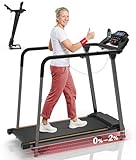 Redliro Treadmill for Seniors with Long Handrails Redliro | 14.8" x 39.3" | 5 mph | 300 lbs | View on Amazon | |
 UREVO SpaceWalk 5L Auto-Incline Walking Pad UREVO | 15.8" x 39.4" | 4 mph | 320 lbs | View on Amazon | |
 WalkingPad MX8 Vertical-Fold Treadmill WalkingPad | 15" x 39.4" | 5 mph | 330 lbs | View on Amazon | |
 GoPlus 2-in-1 Folding Treadmill GoPlus | 16" x 40" | 7.5 mph | 265 lbs | View on Amazon | |
 UREVO SpaceWalk 3S Auto-Incline Walking Pad UREVO | 15" x 40.1" | 4 mph | 265 lbs | View on Amazon | |
 UREVO Strol 2E 2-in-1 Folding Treadmill UREVO | 15" x 40.2" | 6.2 mph | 265 lbs | View on Amazon | |
 Redliro Slow-Start Treadmill for Seniors (0.3 mph) Redliro | 15" x 41" | 5.5 mph | 300 lbs | View on Amazon | |
UREVO CyberPad Auto-Incline Walking Pad UREVO | 16.5" x 42" | 4 mph | 242 lbs | View on Amazon | |
 DeerRun 4-in-1 Walking Pad DeerRun | 16.53" x 44.09" | 7.5 mph | 300 lbs | View on Amazon | |
KingSmith WalkingPad P1 KingSmith | 15.75" x 47" | 3.7 mph | 220 lbs | View on Amazon | |
WalkingPad R3 Hybrid+ 2-in-1 Treadmill WalkingPad | 17" x 47" | 7.5 mph | 265 lbs | View on Amazon | |
 WalkingPad R2 Walk & Run 2-in-1 Folding Treadmill WalkingPad | 17" x 47" | 7.5 mph | 240 lbs | View on Amazon | |
WALKINGPAD Z1 WalkingPad | 17.3" x 47.2" | 3.7 mph | 242 lbs | View on Amazon | |
WALKINGPAD C2 Folding Walking Pad WalkingPad | 15.75" x 47.2" | 3.73 mph | 220 lbs | View on Amazon | |
 WalkingPad X21 Double-Fold Treadmill WalkingPad | 18.1" x 47.6" | 7.5 mph | 220 lbs | View on Amazon | |
 WalkingPad Z1R Foldable Walking Pad with Handlebar WalkingPad | 15.7" x 47.6" | 5 mph | 242 lbs | View on Amazon | |
 WalkingPad Z3 Just Walk Foldable Walking Pad WalkingPad | 15.7" x 47.6" | 4 mph | 242 lbs | View on Amazon | |
 LifeSpan TX6-GlowUp Under Desk Treadmill LifeSpan | 20" x 48" | 6 mph | 400 lbs | View on Amazon | |
 WalkingPad MX10 Vertical-Fold Treadmill WalkingPad | 16.1" x 48" | 6.5 mph | 265 lbs | View on Amazon |
What Makes a Walking Pad Apartment-Friendly?
An apartment friendly walking pad clears four bars at once: a verified noise rating under roughly 45–50 dB, a weight capacity and mat setup that protects your floors, a folded footprint small enough to disappear into a small unit, and speed habits that respect evening quiet hours. Miss any one of these and even a "quiet" machine can still generate a noise complaint. Here is what each threshold means in practice.
dB thresholds vs. neighbor complaints. The noise number on the box only tells part of the story. Under 40 dB — the UREVO CyberPad (35 dB) and WALKINGPAD Z1 (40 dB) — motor noise is effectively silent to neighbors in adjacent units. Between 40 and 50 dB (the KingSmith P1, WALKINGPAD C2, and WalkingPad R3 Hybrid+ in walk mode), you are apartment-compatible for daytime and early-evening use, but in a wood-frame building with thin floors, that range can register as a low hum through a shared wall after dark. Above 50 dB, complaints become likely near shared walls in the evening. When you shortlist an apartment walking pad, treat 50 dB as the ceiling, not the target.
Weight capacity and floor protection. Every model on this page carries a 220 to 265 pound weight capacity — the WALKINGPAD Z1 and UREVO CyberPad rate 242 lbs, the KingSmith P1 and WALKINGPAD C2 rate 220 lbs, and the WalkingPad R3 Hybrid+ rates 265 lbs. That number matters for two reasons: it confirms the motor can handle your body weight without the strain that increases noise over time, and it is a reminder that repeated footfall at that weight needs a buffer between the belt and your floor. A 6mm-or-thicker rubber equipment mat is the standard fix — it protects hardwood and laminate from impact marks while absorbing the vibration that would otherwise travel to the unit below.
Storage footprint. Apartment square footage is often the real constraint, not just noise. The WALKINGPAD Z1 folds flat to 4.4 inches and slides under a bed or couch; the WALKINGPAD C2 folds to 5.4 inches. The WalkingPad R3 Hybrid+ double-folds upright to stand in a corner instead of sliding under furniture. The UREVO CyberPad is the outlier: it does not fold, so it only makes sense if you have a dedicated spot to leave it in place. If floor space is tight, storage footprint should carry as much weight in your decision as the dB rating.
Evening-use etiquette. Even a quiet model can feel inconsiderate if you run it late. Keep walking speed to 1.5–2.5 mph after 9 PM — motor noise and footfall impact both increase meaningfully above 3 mph — and check your lease for posted quiet hours before building a late-night habit. Paired with a mat and a sub-45 dB machine, this is what keeps an apartment walking pad from becoming a source of friction with the people below you.
UREVO CyberPad — Quietest Verified in 2026 (Under 35 dB)
Best for: Apartment dwellers who want the absolute lowest noise floor, especially those who also want incline walking for higher calorie burn.
The UREVO CyberPad is the new quietest walking pad in our lineup, verified by UREVO at under 35 dB during normal walking use. To put that in perspective: 35 dB is the ambient noise level of a library reading room, quieter than a refrigerator hum, and quiet enough to use during a video call without registering on a standard laptop microphone. The NIDCD places 35 dB well below any noise-risk threshold — you could walk on it for hours daily without concern.
The CyberPad also comes with 14% automatic incline, the highest on this page, which significantly increases calorie burn at the same walking speed. Its 2.5 HP dual brushless motor is rated for 6,000+ hours of use. The belt is 16.5 by 42 inches — slightly shorter in length than the Z1 and P1 (42 vs 47 inches), but wide enough for comfortable walking at desk speeds up to 4 mph. Weight capacity is 242 pounds. The UREVO app provides auto-logging, scenic virtual routes, and AI-guided music sync.
The key trade-off is storage: the CyberPad does not fold flat. It slides under a standing desk but cannot be stored under a bed or couch like the folding models. If apartment floor space is tight and you need to stash your machine away, this matters. If you have a dedicated home-office corner and can leave it in place, this model has the lowest published noise figure in our comparison. See our best walking pads with incline guide for a deeper look at how the CyberPad stacks up on incline performance.
CyberPad bottom line: The quietest walking pad in 2026 at under 35 dB, with 14% auto-incline and a motor rated for 6,000+ hours. Trade-off: no flat-fold storage. The right choice for buyers who want the quietest possible setup and are willing to leave it in place.

UREVO CyberPad Auto-Incline Walking Pad
by UREVO
Best for: Incline walking and high-calorie burn in a quiet office-friendly pad
Key Features
- 2.5 HP dual brushless motor rated for 6,000+ hours
- 14% automatic incline for higher calorie burn
Pros
- + 14% auto incline burns substantially more calories than flat pads
- + Whisper-quiet brushless motor rated below 35 dB
Cons
- - Does not fold — fixed deck takes more storage space
- - 4 mph max — walking and incline focused, not for running
WALKINGPAD Z1 — Best Value Quiet Pick (40 dB)
Best for: Apartment dwellers who want verified quiet operation with flat-fold storage at the best price.
The WALKINGPAD Z1 is our top value pick for apartment use in 2026 and the direct replacement for the discontinued A1 Pro on every noise-relevant dimension. It runs at a verified 40 decibels at walking speed — the same noise floor as the A1 Pro — while offering a wider belt (17.3 inches vs the A1 Pro's 16.5 inches) and costing $200 less. For most apartment walkers who want both quiet operation and storage flexibility, the Z1 is the right answer.
At 40 dB, the Z1 is quiet enough to use during video calls without being picked up by standard laptop microphones. It sits at the same level as a refrigerator hum and is inaudible in the next room with a standard interior door closed. The Z1's 17.3 by 47.2-inch belt is the widest available under $400 — meaningful for taller walkers who would otherwise feel cramped on a narrower surface. See our walking pad belt size guide to check if a 17.3-inch belt fits your natural stride.
The Z1 is walk-only with a 3.7 mph top speed. It folds completely flat to a 4.4-inch height for storage under a bed or couch — a significant practical advantage for studio and one-bedroom apartment dwellers. There is no fixed handrail, making it compatible with any standing desk setup. Weight capacity is 242 pounds.
Z1 bottom line: Verified 40 dB, 17.3-inch-wide belt, folds to 4.4 inches. The best balance of noise, storage flexibility, and price for apartment use.

WALKINGPAD Z1
by WalkingPad
Best for: Widest belt and longest stride at mid-range price
Key Features
- 0.75 HP brushless motor (continuous duty)
- Industry-leading belt width at 17.3 inches
Pros
- + Widest belt at 17.3 inches — most spacious feel
- + 47.2-inch length matches premium models
Cons
- - Walking only — 3.7 mph max
- - Smaller motor at 0.75 HP
KingSmith WalkingPad P1 — Editor's Choice Long Belt
Best for: Buyers who want KingSmith brand quality with a 47-inch belt and a well-reviewed track record.
The KingSmith P1 is the Editor's Choice walking pad on this site for good reason. It uses a brushless-lineage motor design — the same technology philosophy that made the A1 Pro the quietest walking pad of its generation — packaged into a 47-inch-belt machine. We estimate the P1 at 42–48 dB based on its motor type and KingSmith's track record. In practice, this puts it clearly in apartment-compatible territory — quieter than a dishwasher, quieter than most conversations, inaudible through a closed door at walking speeds.
The P1's belt is 15.75 by 47 inches. This length matches the Z1 and the A1 Pro at 47 inches, giving taller walkers the runway they need. The width is 15.75 inches, slightly narrower than the Z1's 17.3 inches — a reasonable trade-off if you prefer KingSmith's brand reputation and the reassurance of over 1,300 verified Amazon reviews. The P1 folds flat, has no fixed handrail, and operates in the 1.0 to 3.7 mph range. Rated for users up to 220 pounds.
P1 bottom line: The best-known quiet walking pad brand in a 47-inch-belt machine. Estimated 42–48 dB — apartment-friendly but louder than the Z1 on available data. The right choice if proven brand confidence and a long review base matter to you.

KingSmith WalkingPad P1
by KingSmith
Best for: Budget-conscious tall users
Key Features
- 1 HP brush motor
- Nearly as long as A1 Pro at a lower price
Pros
- + 47-inch belt nearly matches the A1 Pro
- + Significantly cheaper than A1 Pro
Cons
- - Brush motor is louder than brushless A1 Pro
- - Slightly narrower belt at 15.75 inches
WALKINGPAD C2 — Long Belt, Flat-Fold
Best for: Walkers who want a 47.2-inch belt with footstep induction auto-speed and the WALKINGPAD brand quality.
The WALKINGPAD C2 offers a 47.2-inch belt — the same length as the premium Z1 and the discontinued A1 Pro — in a walk-only machine with footstep induction auto-speed control. The footstep induction feature is a differentiator: it reads your walking pace and adjusts motor speed automatically, so you do not need a remote to change speed mid-session. It sits above the P1 in price, so compare carefully before buying.
We do not have an independently measured dB level for the C2. Based on its 2.0 HP motor and WalkingPad brand lineage, we expect it to fall below 50 dB at walking speeds — apartment-compatible, but likely louder than the Z1's 40 dB floor. The C2 folds flat to 5.4 inches and is rated for users up to 220 pounds. Amazon prices on this model have fluctuated; verify current pricing before purchasing.
C2 bottom line: A 47.2-inch belt with footstep induction auto-speed and flat-fold storage. Compare it carefully against the Z1 and P1 before buying — the C2 costs more while being less well-documented on noise.

WALKINGPAD C2 Folding Walking Pad
by WalkingPad
Best for: Budget-conscious walkers who want a long belt
Key Features
- 2.0 HP motor
- 47.2-inch belt — same length as the premium A1 Pro
Pros
- + 47.2-inch belt matches the premium A1 Pro at a fraction of the cost
- + Folds flat to 5.4 inches — slides under beds and sofas
Cons
- - Walking only — 3.73 mph max, no running mode
- - 220 lb weight limit
WalkingPad R3 Hybrid+ — Premium Quiet Walk + Run
Best for: Apartment dwellers who want quiet desk-hour walking and running capability when noise is less critical.
A quick note: the product linked here carries the id "walkingpad-r2" in our catalog but is now the WalkingPad R3 Hybrid+, KingSmith's direct successor to the discontinued R2. If you came here searching for the R2, the R3 Hybrid+ is its replacement and what you should buy today.
The WalkingPad R3 Hybrid+ is the premium 2-in-1 in our apartment-friendly lineup. Lower the height-adjustable handrail and it operates as a quiet under-desk walking pad to roughly 4 mph; raise the handrail to run, and it reaches 7.5 mph. In walk mode, its brushless motor is consistent with KingSmith's R-series tradition — we estimate below 50 dB at walking speeds, which is apartment-compatible. At running speeds above 5 mph, motor noise increases meaningfully and is not suitable for late-night apartment use.
The R3 Hybrid+'s belt is 17 by 47 inches — wide and long, appropriate for tall walkers. The double-fold design lets it store upright in a corner, saving floor space compared to flat-fold models. One-piece aluminum-alloy frame, 265-pound capacity, KS Fit app, fully assembled out of the box.
R3 Hybrid+ bottom line: The premium 2-in-1 pick for buyers who need apartment-compatible quiet walking at a standing desk and occasional running capability. Walk quietly during work hours; run when noise matters less.
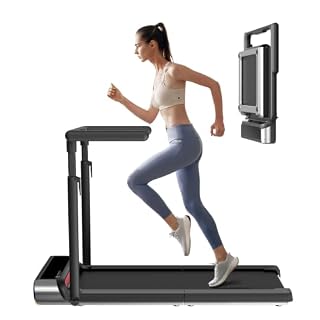
WalkingPad R3 Hybrid+ 2-in-1 Treadmill
by WalkingPad
Best for: Premium walk-run versatility with upright storage
Key Features
- Brushless motor, 0.5-7.5 mph (4 mph in under-desk mode, up to 7.5 mph with handrail raised)
- 2-in-1: lower the height-adjustable handrail to walk under a desk, raise it to run
Pros
- + Genuine walk-and-run: 4 mph under-desk mode, 7.5 mph with the handrail raised
- + Double-folds and stores upright — minimal storage footprint
Cons
- - Premium price point
- - Heavier than walk-only pads
Are Walking Pads Loud Enough to Bother Neighbors?
The answer depends on three things: the machine's actual dB level, your floor and wall construction, and how you set it up. Apartment buildings with concrete-core construction dampen sound far better than wood-frame buildings with thin drywall. In a wood-frame building, any machine above 50 dB at the motor can be noticeable in adjacent units.
Here is what the numbers mean in practice for a typical apartment setting:
Under 40 dB (UREVO CyberPad, WALKINGPAD Z1): Effectively silent for neighbors. In a quiet room, you will hear it running, but it will not carry through walls or floors at normal walking speeds. Safe for evening use in almost any apartment type.
40–50 dB (KingSmith P1, C2, R3 Hybrid+ walk mode): Apartment-compatible for daytime and early evening use. In wood-frame buildings with thin floors, you may want to add a mat and stay below 3 mph at night. In concrete or brick-core buildings, this range is barely perceptible beyond your unit.
Above 50 dB: Not recommended for apartment use near shared walls, especially in the evening. Most basic treadmills fall in the 55–70 dB range — this is why a walking pad, not a treadmill, is the right tool for apartment home offices. See our walking pad vs treadmill comparison for a full breakdown of the size, noise, and price trade-offs.
How to Reduce Walking Pad Noise in an Apartment
The machine is only half the equation. Setup makes a bigger difference than most buyers expect.
Use a thick rubber equipment mat (non-negotiable). This is the single most effective noise-reduction step available. A dense rubber mat at least 6mm thick absorbs footfall vibrations before they enter your floor structure. Without one, even the quietest motor will transmit impact sounds to downstairs neighbors. Expect to spend $25–$50 on a mat — it is the best noise-reduction purchase alongside your walking pad. For full setup guidance, see our walking pad setup and maintenance guide.
Position away from shared walls. Motor hum transmits through drywall into neighboring units. Place your walking pad near the center of your room or against an exterior wall rather than against a shared wall.
Walk at moderate speeds. Motor noise increases significantly above 3 mph. For desk work, 1.5 to 2.5 mph is more comfortable and dramatically quieter than 3.5 to 4 mph. According to Harvard Health, walking at 2 mph still burns 150–200 calories per hour for most adults — this is not a sacrifice.
Wear socks or soft-soled shoes. Hard-soled footwear striking the belt creates sharp impact sounds on top of motor noise. Walking in socks, slippers, or lightweight sneakers reduces percussive footfall noise substantially.
Keep the belt lubricated. A dry belt creates friction noise that builds over time. Apply silicone belt lubricant every 30 to 60 days depending on usage. This keeps your machine as quiet as the day you unboxed it.
What to Look for Before Buying for an Apartment
Verified dB level. Not all "quiet" claims are equal. Only the UREVO CyberPad (under 35 dB) and the WALKINGPAD Z1 (40 dB) on this page carry verified noise measurements. Many brands claim "whisper quiet" without supporting data. The NIDCD places 40 dB at the level of a quiet library — a useful benchmark for assessing manufacturer claims.
No fixed handlebar. Fixed handlebars add structural complexity and potential rattle points. Walk-only machines with no handlebar (Z1, CyberPad, P1, C2) are generally quieter and more compatible with standing desk setups.
Foldable flat. For apartment storage, a machine that folds to under 5 inches high slides under most beds and couches. The Z1 (4.4 inches), P1, and C2 all fold flat. The R3 Hybrid+ double-folds upright. The CyberPad does not fold.
Belt length for your height. A 47-inch or longer belt is appropriate for most adult walkers. If you are above 6 feet tall, belt length matters more than width for comfort. See our walking pad belt size guide for a full breakdown by height. For a broader look at which pads work best in a home office environment, see our home office walking pad guide.
App-free operation. If you plan to walk during calls, look for a model with a physical remote control so you do not need your phone to adjust speed mid-meeting.
Best Time to Buy a Quiet Walking Pad
Price should come after noise evidence, belt fit, and storage. Once you have narrowed the list, compare the exact model and ASIN with its recent normal selling price rather than relying on a crossed-out list price. Our walking pad deals and current-price page shows the latest available feed for in-stock models.
Our Verdict
For apartment dwellers who want the absolute lowest noise floor, the UREVO CyberPad at under 35 dB is now the benchmark — and it brings 14% auto-incline for free. For buyers who also need flat-fold storage, the WALKINGPAD Z1 at 40 dB is the best value: same noise floor as the discontinued A1 Pro, wider belt, lower price. For KingSmith brand confidence with a proven review base, the P1 is the Editor's Choice. And anyone who wants both quiet desk walking and running gets the WalkingPad R3 Hybrid+ — the discontinued R2's direct successor.
All five are apartment-compatible. All five are in stock. Pair any of them with a proper vibration-dampening mat and you have a setup your downstairs neighbors will never notice.
For the full walking pad comparison across every use case — not just noise — see our best walking pads 2026 guide. If you are deciding between a walking pad and a full treadmill for your apartment, our walking pad vs treadmill comparison covers the size, noise, and budget trade-offs in detail.
TheBestWalkingPads.com is a participant in the Amazon Services LLC Associates Program. We earn a small commission on qualifying purchases at no extra cost to you.